
The Ripple Practice is an invitation to slow down, make something with your hands, and notice the people around you more closely.
Sometimes it happens around a table, where people set aside their roles for a while and simply make and talk together. Sometimes it lives in a community, where handmade tokens move from one person to another, carrying attention with them.
The form is not the point.
The attention is.

What happens when we make space to be human?
So much of daily life asks us to be useful, productive, responsive, or good at something.
The Ripple Practice creates a different kind of space.
We make with our hands without needing to produce something impressive. We slow down enough to notice what is happening—in ourselves, between us, and around us. Conversation happens without an agenda. Roles get set down. People who may have arrived as strangers begin to encounter one another as people.
Sometimes what we make stays in the room. Sometimes it leaves our hands and becomes an invitation to connect with someone beyond it.
The work is open-ended. The structure is not.
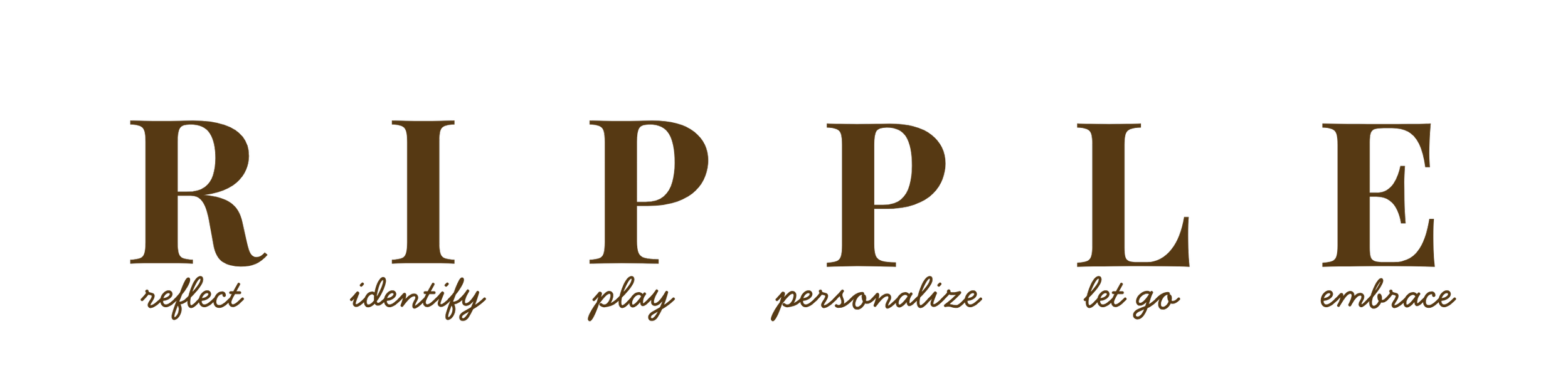
Over the years, I noticed that the same six movements kept appearing in the spaces I created:
Reflect. Identify. Play. Personalize. Let go. Embrace.
Together, they spell RIPPLE.
They are not steps toward a predetermined feeling, and they are not a sequence participants must complete. Sometimes play creates the room for reflection. Sometimes letting go begins before anything has been made. The movements may overlap, repeat, or remain almost invisible.
They are the structure beneath both forms of the work: the Ripple Station™ and the Ripple Experience™.
I developed the Ripple Practice through work that began in 2018. Since then, I have personally given more than 3,000 handmade tokens, created the first public Ripple Station, and facilitated the work with children, adults, and community groups. The research that follows helps me understand some of what I have observed; it does not replace those observations or turn them into proof.
The Ripple Practice takes two forms.
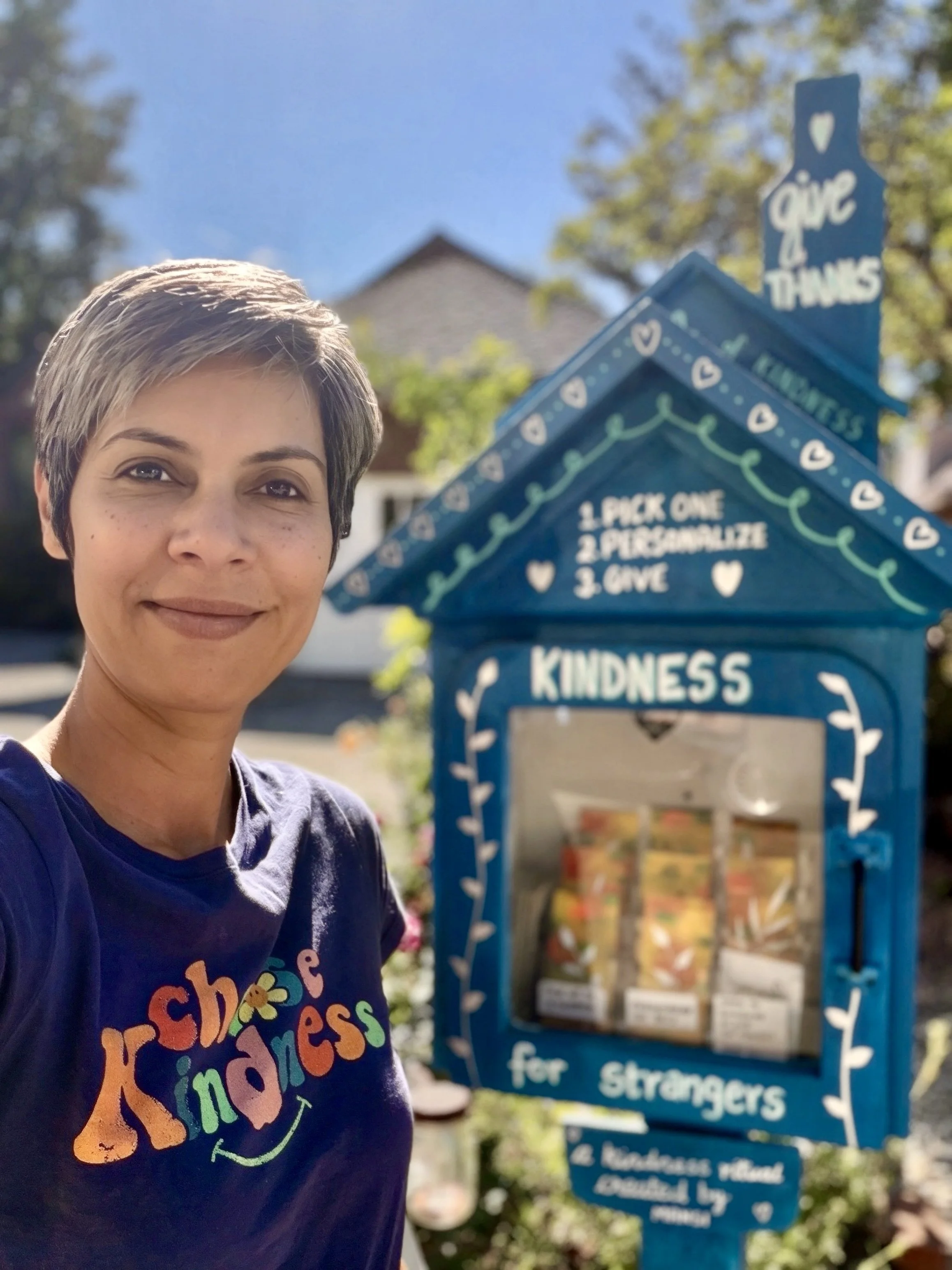
A Ripple Station is a community-held way for handmade tokens to move from one person to another.
Someone takes a token, thinks of a person whose contribution often recedes into the background, asks their name, adds a few words meant specifically for them, and gives it to them.
The token is small. What it makes possible is not.
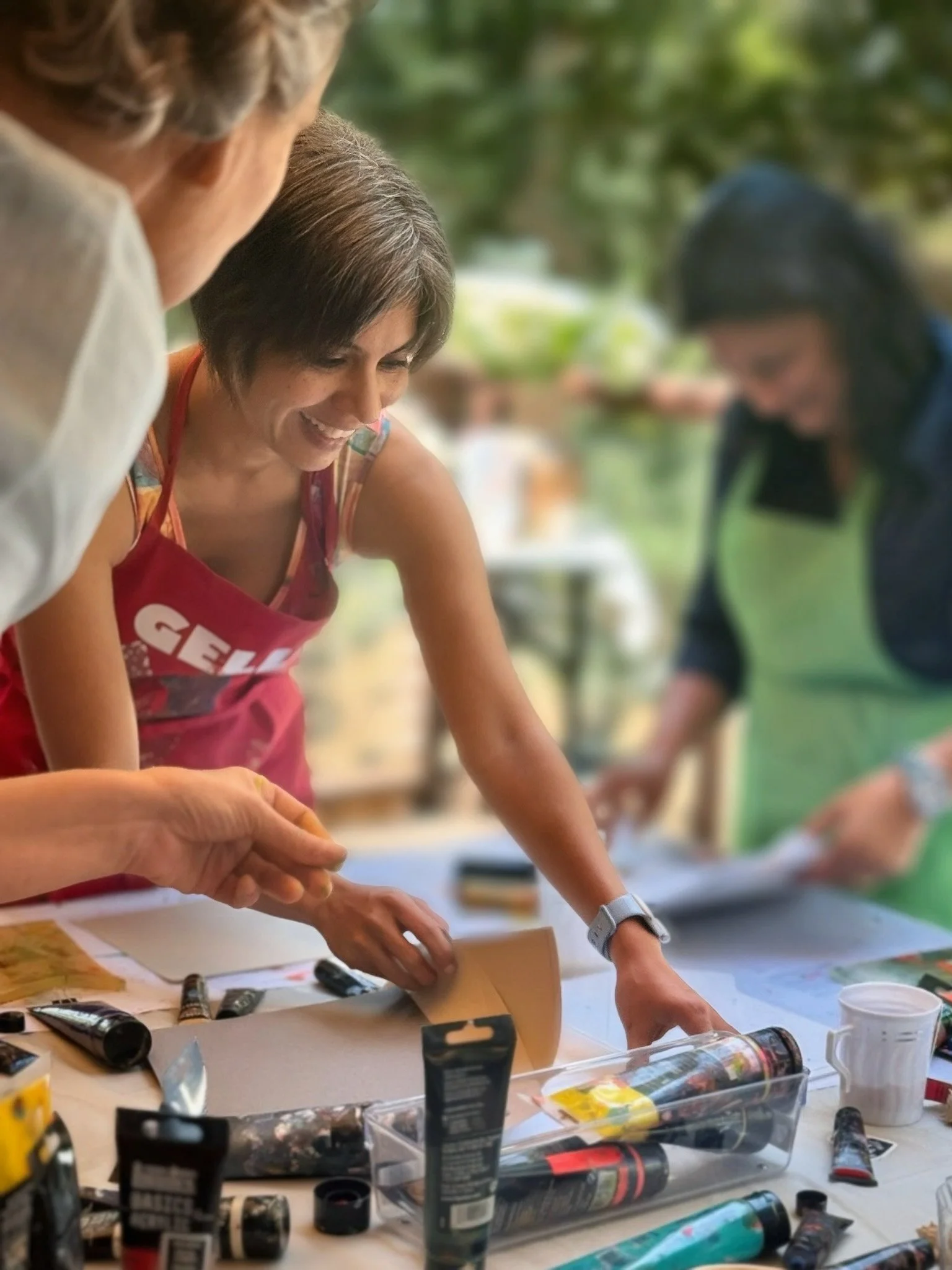
A facilitated gathering where people make with their hands, set their roles down for a while, and connect through conversation. There is no model to reproduce and no emotional destination participants are expected to reach.
The six Ripple movements hold the structure. What happens within that structure belongs to the people in the room.
None of the studies tested the Ripple Practice itself.*
The research below offers context for these movements.
Reflect
We begin by pausing long enough to notice what we are carrying before we start—a sensation, a question, a person, or something we cannot yet put into words.
In one small study, 39 adults made art for 45 minutes. Most had lower cortisol afterward, regardless of their previous art experience, and many described the session as relaxing, freeing, or a way to learn something about themselves (Kaimal, Ray & Muñiz, 2016).
The researchers measured the same people before and after a single art-making session without a control group. The study cannot establish that art-making caused the change.
Identify
We identify what is present or getting in the way. It might be a feeling, a worry, or simply not knowing where to begin.
At a Ripple Station, identifying also means noticing a particular person whose work usually disappears into the background. Not “a worker.” Maria. James. The person standing in front of you.
In a brain-imaging study, putting a feeling into words was associated with reduced activity in the amygdala when participants viewed negative emotional images (Lieberman et al., 2007). A later review examined affect labeling as a form of implicit emotion regulation (Torre & Lieberman, 2018).
These were laboratory tasks involving emotional images and words. They did not examine art-making, identifying obstacles, or noticing another person. Naming is not automatically or universally helpful.
Play
We play without a plan: no model to copy, no standard to meet. Materials overlap, marks get covered, and nothing has to become recognizable.
In a study of 255 adults, greater self-reported playfulness was associated with greater life satisfaction and a stronger tendency to pursue enjoyable activities (Proyer, 2013).
In this practice, play matters for a simpler reason: it loosens the demand to perform.
Personalize
We make the experience our own. Participants choose which material to reach for, which mark to follow, which words to write, and which person to notice.
The structure is held. The response belongs to them.
Self-determination theory proposes that autonomy, competence, and relatedness are fundamental psychological needs. Environments that support meaningful choice rather than control are associated with stronger intrinsic motivation and well-being (Ryan & Deci, 2000).
At a Ripple Station, personalization becomes relational. A token is selected for one person and inscribed with words meant specifically for them.
Embrace
We meet what emerged and step into what comes next without deciding too quickly whether it is beautiful, meaningful, successful, or finished.
We claim the work now—not after another class, when we feel more certain, or when we finally believe we are ready.
This movement has affinities with research on self-compassion: meeting one’s experience with self-kindness, mindful awareness, and a recognition of common humanity rather than harsh judgment or isolation (Neff, 2003).
At the Stations, embracing also moves outward as acknowledgment. Across four experiments, people who were thanked reported a greater sense of social worth and were more likely to help again (Grant & Gino, 2010).
The gratitude experiments involved people being thanked for helping someone. They did not involve handmade tokens, strangers, or people in service roles.
Let go
A mark may be covered by someone else. A shared painting may be cut into dozens of pieces. A token may be offered without knowing how it will be received.
Researchers use the term psychological flexibility to describe the capacity to adapt to what a situation asks, remain open to experience, and continue acting in alignment with one’s values (Kashdan & Rottenberg, 2010).
The Ripple Practice does not claim that cutting up or giving away a piece of art creates psychological flexibility. It offers a small, physical encounter with releasing ownership and control.
*Some of the sources describe broad theories or associations rather than experiments involving participatory art, and none establishes that the corresponding Ripple movement produces the outcomes studied. Last reviewed October 2026.
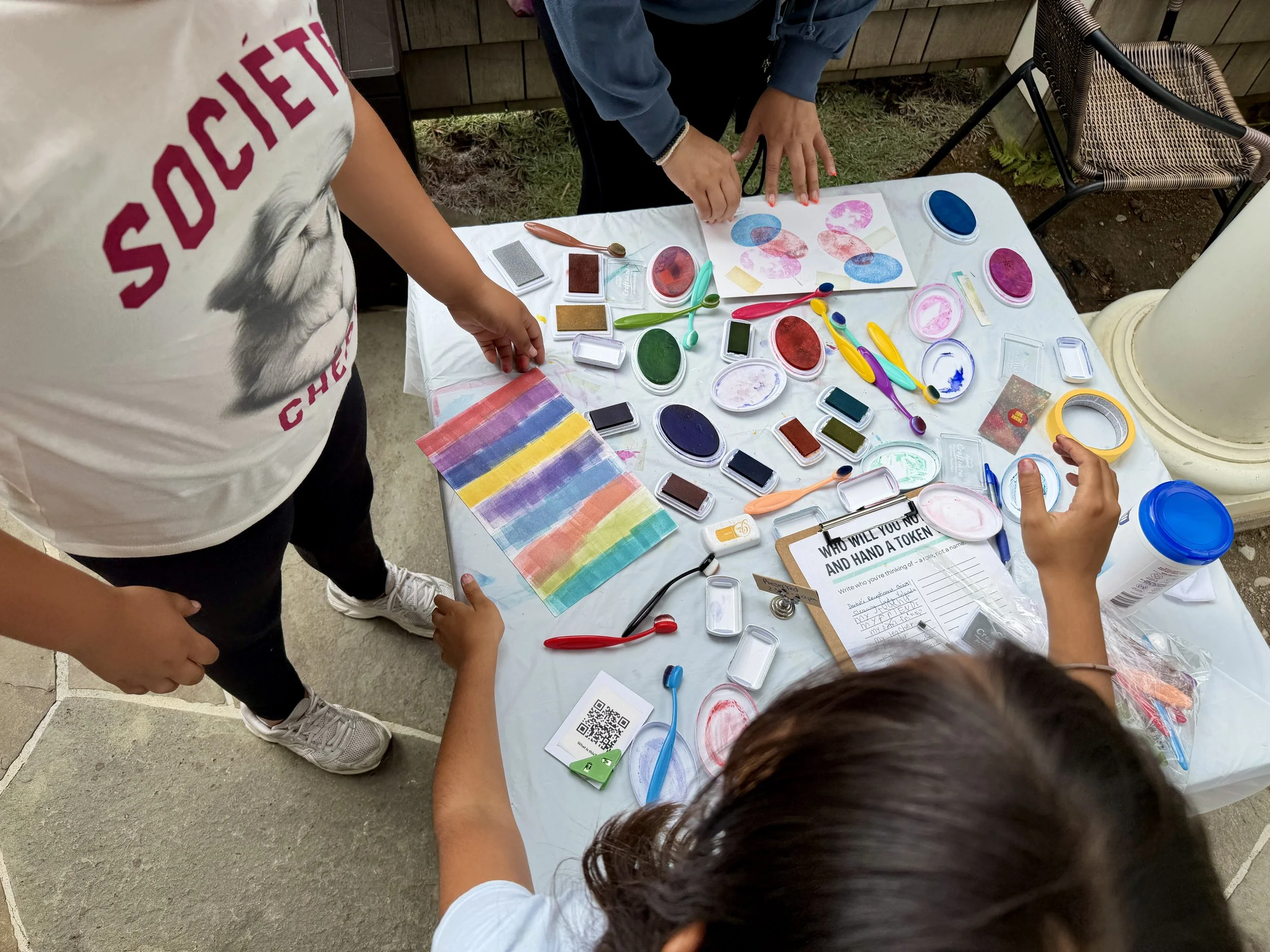
What research suggests about small acts of recognition
A small gesture can be easy to dismiss, particularly when we are the ones considering whether to offer it. Several studies suggest that people consistently underestimate what brief acts of appreciation, kindness, and connection may mean to someone else.
People writing thank-you letters underestimated how surprised and happy recipients would feel and overestimated how awkward the recipients would feel (Kumar & Epley, 2018).
People performing small acts of kindness underestimated how positively recipients would experience those acts (Kumar & Epley, 2022).
Commuters asked to speak with a stranger reported a more positive experience than commuters asked to remain disconnected, even though people predicted that conversation would make the journey less pleasant (Epley & Schroeder, 2014).
People reported greater happiness and belonging on days when they interacted with more acquaintances and other “weak ties” (Sandstrom & Dunn, 2014a).
In a field experiment, customers asked to have a brief social interaction with a barista reported greater positive emotion and belonging than customers asked to make the exchange as efficient as possible (Sandstrom & Dunn, 2014b).
What this research cannot tell us: None of these studies involved Ripple tokens or examined the practice as a whole. The weak-ties findings include correlational evidence, and none of the studies demonstrates that every attempted interaction will feel meaningful or welcome.
An unexpected interaction will not feel comfortable to everyone. The practice includes respecting that possibility, accepting a refusal, and releasing the need to control another person’s response.
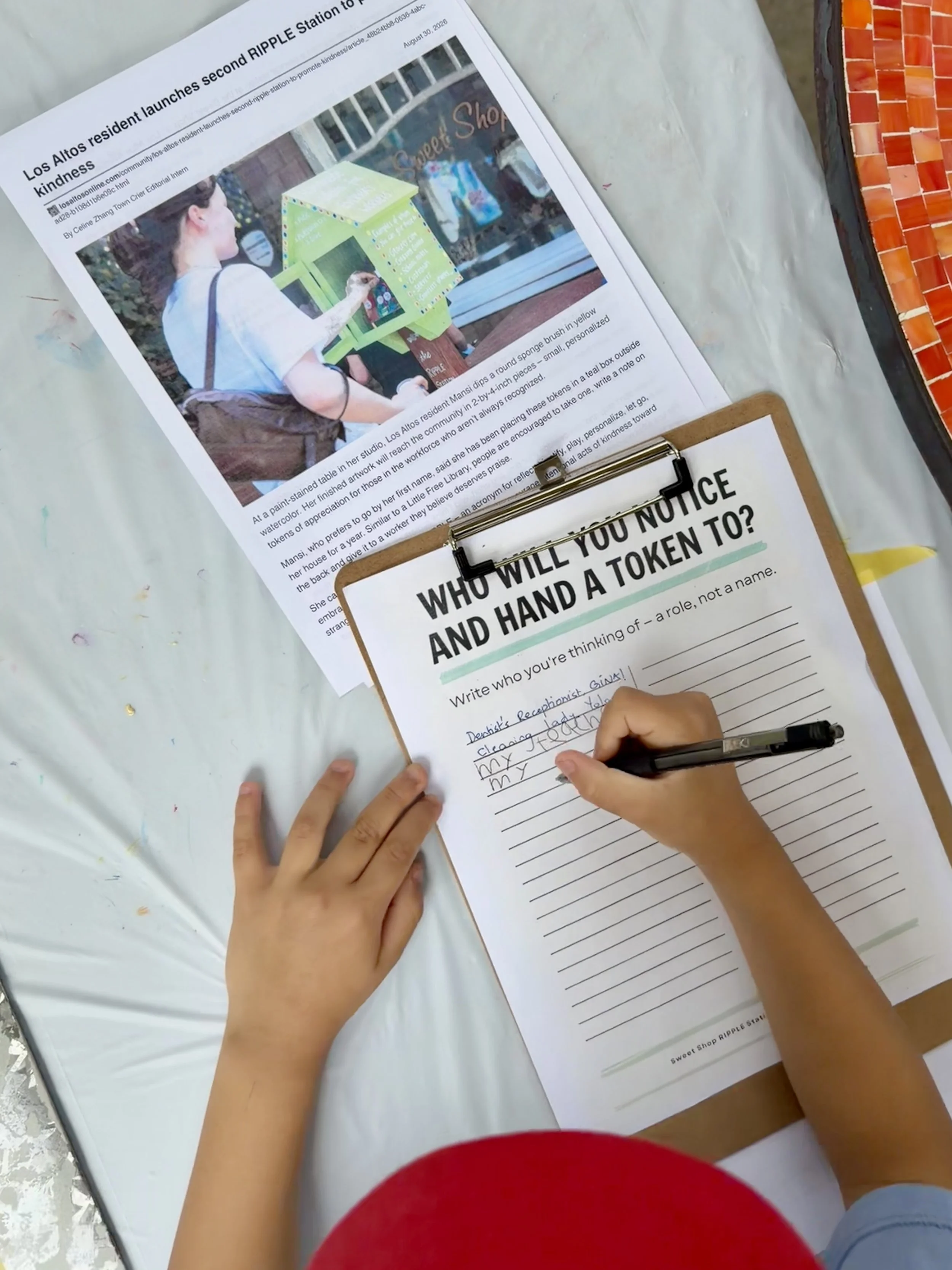
What “research-informed” means here
The studies referenced on this page did not test the Ripple Practice as a method. They do not show that a gathering or Station will produce a particular psychological result.
They offer context for some of the choices within the design: pausing before acting, naming what is present, playing without a predetermined result, preserving participant choice, releasing control, meeting experience with less judgment, and making appreciation specific.
The practice itself grew through observation.
Since 2018, I have handed more than 3,000 small, handmade tokens to people whose work often goes unseen. Neighbors took nearly 1,000 tokens from the first Ripple Station in its first year. In its first month, community members took approximately 500 more from the Sweet Shop Station to give to someone.
I do not yet know what happens after every token leaves a Station. I have not measured whether the practice changes behavior, increases connection, or produces a lasting effect. I am still working out how to study those questions honestly.
The research matters. So do the limits of what it can tell us.
This is a practice, not a prescription.
References
Epley, N., & Schroeder, J. (2014). Mistakenly seeking solitude. Journal of Experimental Psychology: General, 143(5).
Grant, A. M., & Gino, F. (2010). A little thanks goes a long way: Explaining why gratitude expressions motivate prosocial behavior. Journal of Personality and Social Psychology, 98(6), 946–955.
Kaimal, G., Ray, K., & Muñiz, J. (2016). Reduction of cortisol levels and participants’ responses following art making. Art Therapy, 33(2), 74–80.
Kashdan, T. B., & Rottenberg, J. (2010). Psychological flexibility as a fundamental aspect of health. Clinical Psychology Review, 30(7), 865–878.
Kumar, A., & Epley, N. (2018). Undervaluing gratitude: Expressers misunderstand the consequences of showing appreciation. Psychological Science, 29(9), 1423–1435.
Kumar, A., & Epley, N. (2023). A little good goes an unexpectedly long way: Underestimating the positive impact of kindness on recipients. Journal of Experimental Psychology: General, 152(1), 236–252.
Lieberman, M. D., Eisenberger, N. I., Crockett, M. J., Tom, S. M., Pfeifer, J. H., & Way, B. M. (2007). Putting feelings into words: Affect labeling disrupts amygdala activity in response to affective stimuli. Psychological Science, 18(5), 421–428.
Neff, K. D. (2003). Self-compassion: An alternative conceptualization of a healthy attitude toward oneself. Self and Identity, 2(2), 85–101.
Proyer, R. T. (2013). The well-being of playful adults: Adult playfulness, subjective well-being, physical well-being, and the pursuit of enjoyable activities. European Journal of Humour Research, 1(1), 84–98.
Ryan, R. M., & Deci, E. L. (2000). Self-determination theory and the facilitation of intrinsic motivation, social development, and well-being. American Psychologist, 55(1), 68–78.
Sandstrom, G. M., & Dunn, E. W. (2014a). Social interactions and well-being: The surprising power of weak ties. Personality and Social Psychology Bulletin, 40(7), 910–922.
Sandstrom, G. M., & Dunn, E. W. (2014b). Is efficiency overrated? Minimal social interactions lead to belonging and positive affect. Social Psychological and Personality Science, 5(4), 437–442.
Torre, J. B., & Lieberman, M. D. (2018). Putting feelings into words: Affect labeling as implicit emotion regulation. Emotion Review, 10(2), 116–124.
Continue the Conversation
The Ripple Practice is still being practiced, observed, and understood. If something here resonates, raises a question, or makes you curious about bringing the Station or Experience into your community, I would be glad to hear from you.