If you read the public post, you know what happened Sunday morning. Five of us around a table, paint on our fingers, three-second marks, no plan. You know about the permission.
This is the part I didn’t put in that post.
When it was my turn to say what I was bringing into the room, I said I was grateful to be alive. That the ER visit two weeks ago had given me a new kind of perspective. That my biggest fear — the one I hadn’t said out loud until that moment — was losing my hands.
Not my health in some general way. My hands. Because if I can’t use my hands, I don't know who I am.
I’m a maker. What would I do without them?
I said it but didn’t linger. The morning wasn’t about me.
But I want to sit with it here, with you, because I think it’s worth naming what it costs to facilitate from that place.
To hold space for other people’s play while something in you is still shaking. I hadn’t painted since that ER visit, so I didn’t even know if I had it in me. But surprisingly, that nervousness went away as soon as the moment my fingers touched the paint.
There’s a moment I keep returning to from Sunday. We had all painted on one sheet together — everyone’s marks on top of everyone else’s. Then I cut it into pieces and handed them out. And I watched each person look at their piece and realize: this has your color in it, and hers, and mine. None of us made this. All of us made this.
Parts of it and parts of each other.
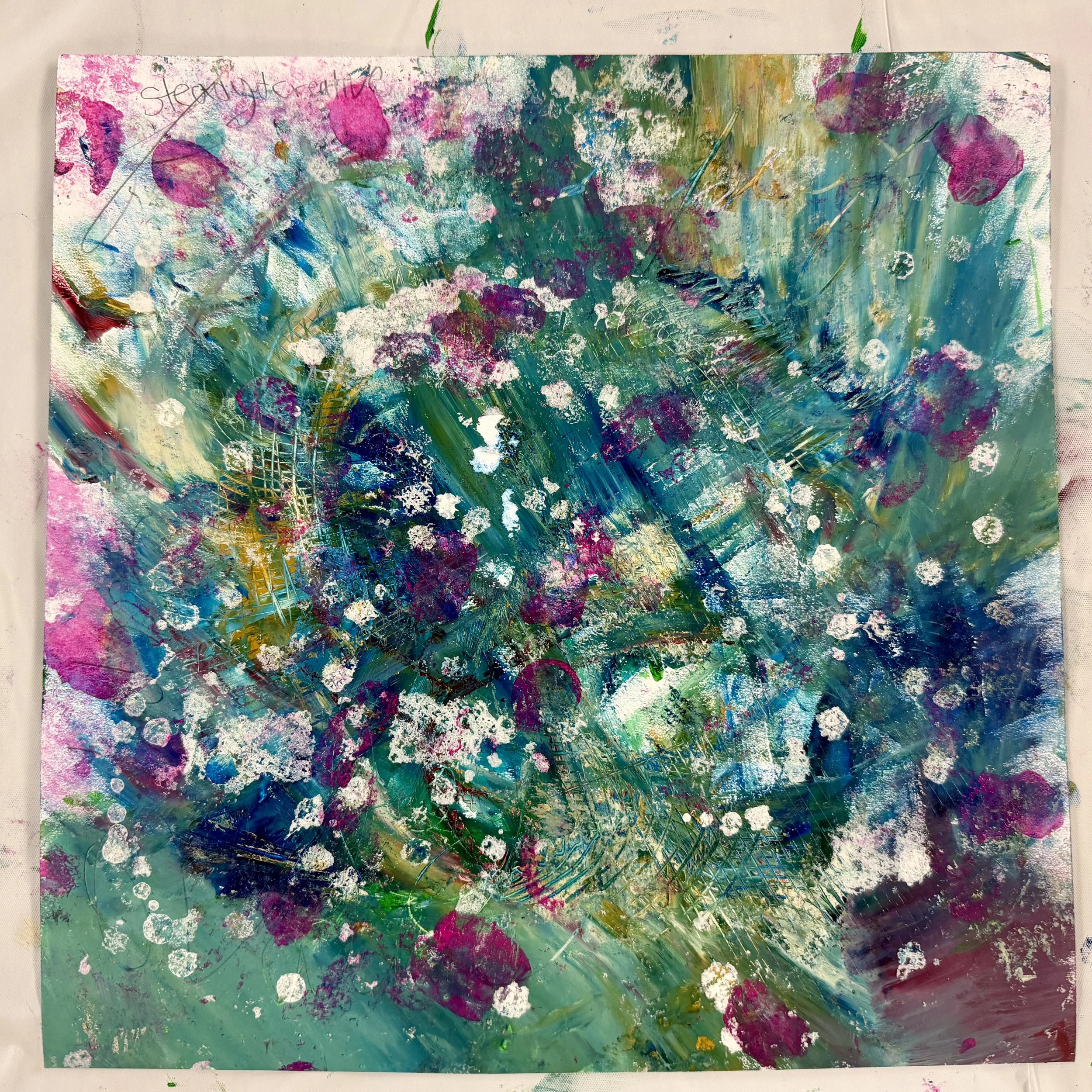
Five strangers’ marks, separated and carried home in five different directions. Already changing into something else the moment they left the room.
I’ve been doing this for eight years with the tokens. Mixing and matching, destroying and recreating, enjoying the process without any expectations of the outcome. And the joy multiplies every time I witness someone else experience this … the RIPPLE Practice.
I also shared with them something that you might have heard me talk about in one of our Zoom calls.
I was at Target with Mira three or four years ago. The cashier was at the end of his shift. I could see it in his body — the way he kept checking his watch, the way he scanned my items without looking up. He was done.
I had a token with me. Gold foil, layered mixed media, one that I’d spent almost an hour making. I handed it to him and said, thank you so much. I really appreciate you.
He took it. And he put it in the trash. Without reading it. Without turning it over. Just — into the bin, and shouted “next customer!”
Mira looked at me. She said: “Say something to him.”
And I thought about it. Because that token had his name on it. I had seen his name tag and written it on the back. It was personal. It was mine. And it was in the trash.
But what I said to her was: “It’s ok. I did my part. Now I just have to let go. This isn’t important to him.”
“But you spent so much time making it!” she pleaded.
“I did,” I said. “And I had fun.”
That had to be enough. If I went back and said something to him, it would’ve become about me. About my need for the gesture to land. And that’s not what this is about.
I don't know if he ever gave it a second look in the trash. I don’t know if someone else found it and gave it to him. I’ll never know.
That was one token. I’ve made close to three thousand.
One.
But I still remember that token. I still remember the gold leaf on it.
The letting go is not a philosophy. It is a practice. And it is the hardest part — harder than the making, harder than the giving. Letting the thing you made go somewhere you can’t follow, and not needing it to arrive.
A different kind of letting go happened in the room on Sunday.

There’s a beautiful painting on the back side of this flower…
I had cut a flower shape from one of my painted papers. I loved the painting. I loved the shape. And when I went to place it on my collage, it didn’t work. The colors fought. The composition was too busy. Everything was screaming for attention and nothing was getting it.
And I watched myself do the thing I tell everyone else to do: I flipped it over. I used the back that had my sketch lines on it. The painting I loved disappeared, and something simpler took its place.
Something that made me exhale.
“It’s okay. It’s just a painting. You will make more.”
I say that to every person who sits with me. On Sunday, I had to say it to myself. And it was still hard. And it was still true.
I keep bringing this back to the table.
That’s why I keep showing up — to the gatherings, to the senior center next month, hopefully to Mira's classroom before the year ends. Not to teach people to make art.
To teach them that the thing they’re afraid of — the ugly phase, the mud, the moment where nothing is working and you don’t know what it's becoming — is the thing.
That is the creative life.
માનસી